May 4, 2026
Capturing consumer attention has never been more challenging. Today's shoppers are constantly bombarded with advertisements across social media, websites, mobile apps, television, and physical retail environments. By the time a customer walks through your doors, they have already encountered hundreds—if not thousands—of competing messages.
For retail brands, the challenge is no longer simply getting products onto shelves. The challenge is capturing attention, influencing purchasing decisions, and creating memorable experiences that encourage customers to return. This is where digital signage has become a powerful competitive advantage.
According to industry research, the global digital signage market is expected to generate over $41 billion in revenue by 2029, while studies have found that digital displays can significantly influence purchasing behavior and increase sales performance compared to traditional printed signage. Retail giants such as Walmart, Nike, Sephora, and Target continue to invest heavily in digital displays as part of broader customer engagement strategies.
However, successful retailers do not view digital signage as merely a collection of screens. Instead, they use it strategically throughout the customer journey—from attracting passersby into the store to influencing purchase decisions at checkout.
Here are ten ways leading retailers are leveraging digital signage to increase foot traffic, improve customer engagement, and drive sales.
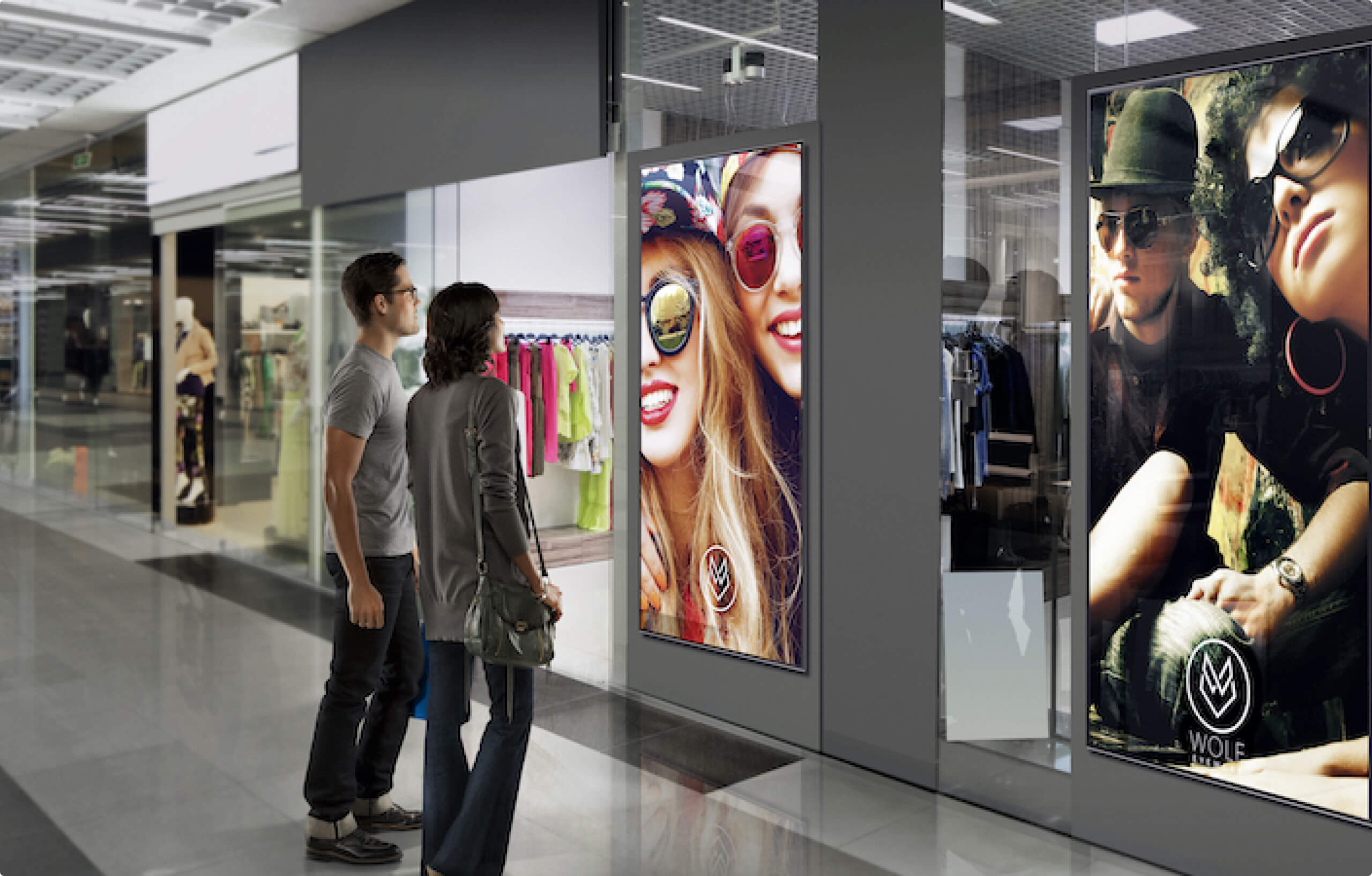
Before a customer can make a purchase, they must first decide to enter your store. In shopping malls, commercial districts, and retail centers, every storefront competes for attention. Static posters and printed displays often struggle to stand out amidst the visual noise created by neighboring stores, promotional banners, and product displays.
Digital signage helps retailers overcome this challenge by introducing movement, brightness, and dynamic content into the storefront environment. From a psychological perspective, humans are naturally drawn to changes in their environment. Researchers refer to a phenomenon known as "change blindness," where individuals unconsciously ignore stimuli that fail to stand out from their surroundings. Motion graphics, video content, changing visuals, and high-contrast imagery help digital displays break through this attention barrier.
Retailers can use storefront displays to:
Unlike printed posters that remain static for weeks or months, digital storefront displays can be updated instantly to remain fresh and relevant.
For marketing teams, this creates a highly visible communication channel that works around the clock to attract potential customers and increase store visits.
One of the most important realities of retail is that many purchasing decisions are made inside the store. Customers may enter with a shopping list, but product comparisons, promotions, and visual merchandising often influence what ultimately ends up in their basket. Digital signage allows retailers to communicate information at precisely the moment customers are making buying decisions.
Research shows that consumers process visual information significantly faster than text. A well-designed product video or promotional graphic can communicate value more effectively than a printed shelf talker or traditional sign.
Retailers commonly use digital signage to:
For example, a beauty retailer may display before-and-after demonstrations, while an electronics store may showcase product features through video content. These displays help reduce uncertainty, educate shoppers, and ultimately increase conversion rates.
When deployed near high-consideration product categories, digital signage becomes an extension of the sales team, helping customers make informed purchasing decisions even when staff are unavailable.
Not all products contribute equally to profitability. Retailers often face the challenge of balancing inventory movement, promotional priorities, and margin objectives. Digital signage provides a flexible platform for directing customer attention toward products that support business goals. Unlike printed signage, which can be expensive and time-consuming to replace, digital displays allow marketing teams to prioritize specific products instantly.
This capability is particularly useful for:
A retailer may choose to promote a premium skincare line, a private-label grocery product, or a newly launched apparel collection depending on current business priorities. Because digital content can be scheduled and updated centrally, marketing teams gain significantly greater control over in-store merchandising strategies. The result is not simply increased sales—but increased profitability.
Large retail environments can be overwhelming. Whether customers are shopping in a department store, supermarket, home improvement center, or specialty retailer, finding specific products can sometimes become a frustrating experience. Digital signage improves product discovery by serving as a navigational and informational tool.
Retailers can deploy displays to:
When customers spend less time searching and more time shopping, overall satisfaction improves.
For retailers, improved navigation delivers additional benefits:
In large-format retail environments, digital wayfinding solutions can significantly enhance the overall customer experience while improving operational efficiency.
Few things negatively impact customer experience more than waiting. Long checkout lines, service queues, and collection counters can quickly create frustration, even when actual wait times are relatively short. Interestingly, customer satisfaction is often influenced more by perceived wait time than actual wait time. Digital signage helps address this challenge by providing engaging content during periods of inactivity.
Retailers frequently place displays near:
These displays can be used to show:
Instead of focusing on waiting, customers remain engaged with the brand. This not only improves the customer experience but also creates additional opportunities to promote products and services during otherwise unproductive moments.
Retail moves quickly. Consumer demand changes, inventory fluctuates, weather conditions shift, and promotional opportunities emerge unexpectedly. Traditional printed signage lacks the flexibility needed to respond to these changes efficiently. Digital signage allows retailers to launch campaigns in real time.
Examples include:
A grocery chain can promote cold beverages during a heat wave. A fashion retailer can highlight rainwear during inclement weather. A department store can immediately update promotions during major shopping events. For marketing teams, this agility creates opportunities to maximize campaign effectiveness while reducing the costs associated with printing and distribution. The ability to react quickly often becomes a competitive advantage.
Today's consumers expect relevance. Generic messaging is becoming less effective as customers increasingly expect experiences tailored to their interests, demographics, and shopping behaviors.
Digital signage enables retailers to deliver more contextually relevant content based on factors such as:
For example, content displayed during weekday mornings may differ significantly from content shown during weekend evenings. Retailers targeting younger demographics may choose more interactive and visually dynamic experiences, while stores serving broader audiences may prioritize clear product information and promotional messaging. The goal is simple: present the right message to the right audience at the right time. When content feels relevant, engagement naturally increases.
The modern customer journey rarely follows a straight line. A shopper may discover a product on social media, research it online, visit a physical store, compare options on their smartphone, and complete the purchase through an app. As retail becomes increasingly omnichannel, digital signage serves as a bridge between physical and digital experiences.
Retailers commonly use displays to promote:
By connecting in-store experiences with digital touchpoints, retailers create a more seamless customer journey. This not only improves convenience but also strengthens customer relationships across multiple channels. For large retail organizations, digital signage has become an important component of broader omnichannel engagement strategies.
Retail success is no longer determined solely by price and product availability. Increasingly, brands compete based on experience. Consumers remember brands that create emotional connections, memorable moments, and compelling stories. Digital signage enables retailers to communicate far more than promotions.
It allows them to showcase:
Research in consumer psychology shows that memorable visual experiences are more likely to influence future purchasing behavior. This is particularly important for premium and luxury retailers, where perception often plays a significant role in purchasing decisions. The objective is not simply to drive today's sale, but to create lasting brand impressions that influence future buying behavior.
Perhaps the most overlooked benefit of digital signage is the data it can generate. Modern digital signage platforms provide retailers with valuable insights into content performance and customer engagement.
Depending on the deployment, retailers can track:
These insights allow marketing teams to continuously optimize messaging and improve return on investment. Rather than relying on assumptions, retailers can make decisions based on measurable performance data. As retail organizations become increasingly data-driven, digital signage is evolving from a communication tool into a strategic business platform capable of supporting marketing, sales, operations, and customer experience initiatives.
The most successful retailers no longer view digital signage as a standalone technology investment. They view it as a strategic tool that supports multiple business objectives simultaneously: attracting customers, improving in-store experiences, increasing sales, strengthening brand perception, and generating valuable operational insights.
When thoughtfully deployed, digital signage influences nearly every stage of the customer journey—from the moment a shopper notices a storefront display to the moment they complete a purchase. For marketing, sales, and purchasing teams within large retail organizations, the question is no longer whether digital signage works. The question is how effectively it is being used to create measurable business results.