






Why Work With Us
Why choose The Brain Computer Corporation for a projector purchase or rental?

The Brain Computer Corporation has supplied and installed AV and sound systems in the Philippines for over 37 years. For sound system projects, this means a few things for you:
- We design around your space, not a generic package. We assess your room's size, layout, and use before recommending speakers, mixers, and microphones — not the other way around.
- We handle the full project. From site visit through installation and testing, our team manages every step.
- We've worked across many sectors. Our project history spans retail, corporate offices, schools, churches, and government buildings across the Philippines.
- Our support team is local. You get installation and troubleshooting help from our own technicians, not an overseas call centre.
- We're PhilGEPS accredited. For schools, universities, and government agencies, we have experience with Philippine public procurement for AV and sound system projects.
Who are some of The Brain Computer Corporation’s trusted clients?
The Brain Computer Corporation has worked with a wide range of clients, including the Department of Finance, Malacañang Palace, Makati City Hall, Department of Agrarian Reform, Bank of the Philippine Islands, IBM, Jollibee Foods Corp, and Convergys.
Do you serve clients outside of Metro Manila?
Yes. The Brain Computer Corporation serves clients across the Philippines, including key commercial centres in Cebu, Davao, Iloilo, Bacolod, Cavite, La Union, Bataan and other provincial and regional locations.
For projects outside Metro Manila, our team coordinates site visits, installation schedules, and after-sales support based on each project's specific location and requirements. Contact us to discuss your project location and we will advise on timelines and logistics.
For projects outside Metro Manila, our team coordinates site visits, installation schedules, and after-sales support based on each project's specific location and requirements. Contact us to discuss your project location and we will advise on timelines and logistics.
All About Sound Systems
What are the main parts of a commercial sound system?
A commercial sound system has four core parts. Each one plays a different role.
Sound sources start the chain. These include microphones, laptops, music players, and streaming devices. Every sound system needs at least one source.
Mixers blend multiple sources into one clean output. If you have a microphone, a laptop, and background music all running at once, the mixer lets you balance them. You can also adjust volume and tone for each source on its own.
Amplifiers boost the signal from the mixer. Speakers need this boosted power to produce sound at a useful volume. Without an amplifier, the signal stays too weak to hear clearly.
Speakers turn the amplified signal into sound. They come in many types: ceiling speakers, wall-mounted speakers, and freestanding speakers, to name a few.
Some products combine two of these parts. A mixer-amplifier, for example, blends sources and boosts the signal in a single unit. This simplifies setup for smaller spaces.
Sound sources start the chain. These include microphones, laptops, music players, and streaming devices. Every sound system needs at least one source.
Mixers blend multiple sources into one clean output. If you have a microphone, a laptop, and background music all running at once, the mixer lets you balance them. You can also adjust volume and tone for each source on its own.
Amplifiers boost the signal from the mixer. Speakers need this boosted power to produce sound at a useful volume. Without an amplifier, the signal stays too weak to hear clearly.
Speakers turn the amplified signal into sound. They come in many types: ceiling speakers, wall-mounted speakers, and freestanding speakers, to name a few.
Some products combine two of these parts. A mixer-amplifier, for example, blends sources and boosts the signal in a single unit. This simplifies setup for smaller spaces.
What types of speakers are used in commercial sound systems?
Commercial spaces use several speaker types, each suited to a different need.
Ceiling speakers sit flush in the ceiling, with only a small grille visible. They work well for background music and announcements in offices, retail stores, and hallways. They blend into the space and don't take up floor or wall room.
Surface-mount speakers attach to a wall or ceiling using a visible bracket. They often deliver more volume and clarity than ceiling speakers, which makes them a good fit for conference rooms, classrooms, and spaces where sound quality matters more than a hidden installation.
Pendant and column speakers hang or stand in open spaces with high ceilings — gyms, warehouses, and large halls, for example. They project sound further and more evenly across a big area.
Outdoor and weatherproof speakers are built to handle rain, heat, and humidity. They suit patios, outdoor dining areas, and covered walkways.
The right speaker type depends on your room's size, ceiling height, and how the space gets used day to day.
Ceiling speakers sit flush in the ceiling, with only a small grille visible. They work well for background music and announcements in offices, retail stores, and hallways. They blend into the space and don't take up floor or wall room.
Surface-mount speakers attach to a wall or ceiling using a visible bracket. They often deliver more volume and clarity than ceiling speakers, which makes them a good fit for conference rooms, classrooms, and spaces where sound quality matters more than a hidden installation.
Pendant and column speakers hang or stand in open spaces with high ceilings — gyms, warehouses, and large halls, for example. They project sound further and more evenly across a big area.
Outdoor and weatherproof speakers are built to handle rain, heat, and humidity. They suit patios, outdoor dining areas, and covered walkways.
The right speaker type depends on your room's size, ceiling height, and how the space gets used day to day.
How many speakers do I need for my space?
The right number depends on your room's size, ceiling height, and how evenly you want sound to spread. As a general guide, speakers should be placed so their coverage areas overlap slightly. This avoids dead zones, where sound feels noticeably quieter than the rest of the room.
For a small office or retail space with a standard 8 to 12-foot ceiling, ceiling speakers placed roughly every 12 to 15 feet usually give even coverage. Larger or more open spaces — gyms, warehouses, big retail floors — often need fewer but more powerful speakers spaced further apart, or a combination of speaker types to handle both near and far areas of the room.
A site visit is the most reliable way to get this right. The Brain Computer Corporation can assess your space and recommend the speaker count, type, and placement suited to your specific layout.
For a small office or retail space with a standard 8 to 12-foot ceiling, ceiling speakers placed roughly every 12 to 15 feet usually give even coverage. Larger or more open spaces — gyms, warehouses, big retail floors — often need fewer but more powerful speakers spaced further apart, or a combination of speaker types to handle both near and far areas of the room.
A site visit is the most reliable way to get this right. The Brain Computer Corporation can assess your space and recommend the speaker count, type, and placement suited to your specific layout.
What types of microphones are used in commercial sound systems?
The right microphone depends on how it will be used.
Dynamic microphones are rugged and handle loud sound well. They work well on stages, in churches, and for any setting where the microphone gets passed around or used by different speakers.
Condenser microphones pick up softer, more detailed sound. They suit boardrooms, classrooms, and any setting where someone speaks at a normal volume from a fixed position, like a podium or a conference table.
Wireless microphones free the speaker from being tied to a cable. This works well for presenters who move around a stage or room. Wired microphones, on the other hand, offer the most reliable connection with no risk of signal dropout, which matters for events where a reliable signal is critical.
Lavalier (clip-on) microphones attach to clothing and free up the speaker's hands. They're a common choice for teachers, trainers, and presenters who need to move and gesture while speaking.
Dynamic microphones are rugged and handle loud sound well. They work well on stages, in churches, and for any setting where the microphone gets passed around or used by different speakers.
Condenser microphones pick up softer, more detailed sound. They suit boardrooms, classrooms, and any setting where someone speaks at a normal volume from a fixed position, like a podium or a conference table.
Wireless microphones free the speaker from being tied to a cable. This works well for presenters who move around a stage or room. Wired microphones, on the other hand, offer the most reliable connection with no risk of signal dropout, which matters for events where a reliable signal is critical.
Lavalier (clip-on) microphones attach to clothing and free up the speaker's hands. They're a common choice for teachers, trainers, and presenters who need to move and gesture while speaking.
Do I need a wireless or wired microphone system?
This depends on how much the speaker needs to move, and how much you can rely on a stable wireless signal in your space.
Wireless microphones give presenters freedom to walk around a stage, classroom, or boardroom without being tethered to a cable. This makes them a strong fit for trainers, teachers, and anyone who presents standing up and moving.
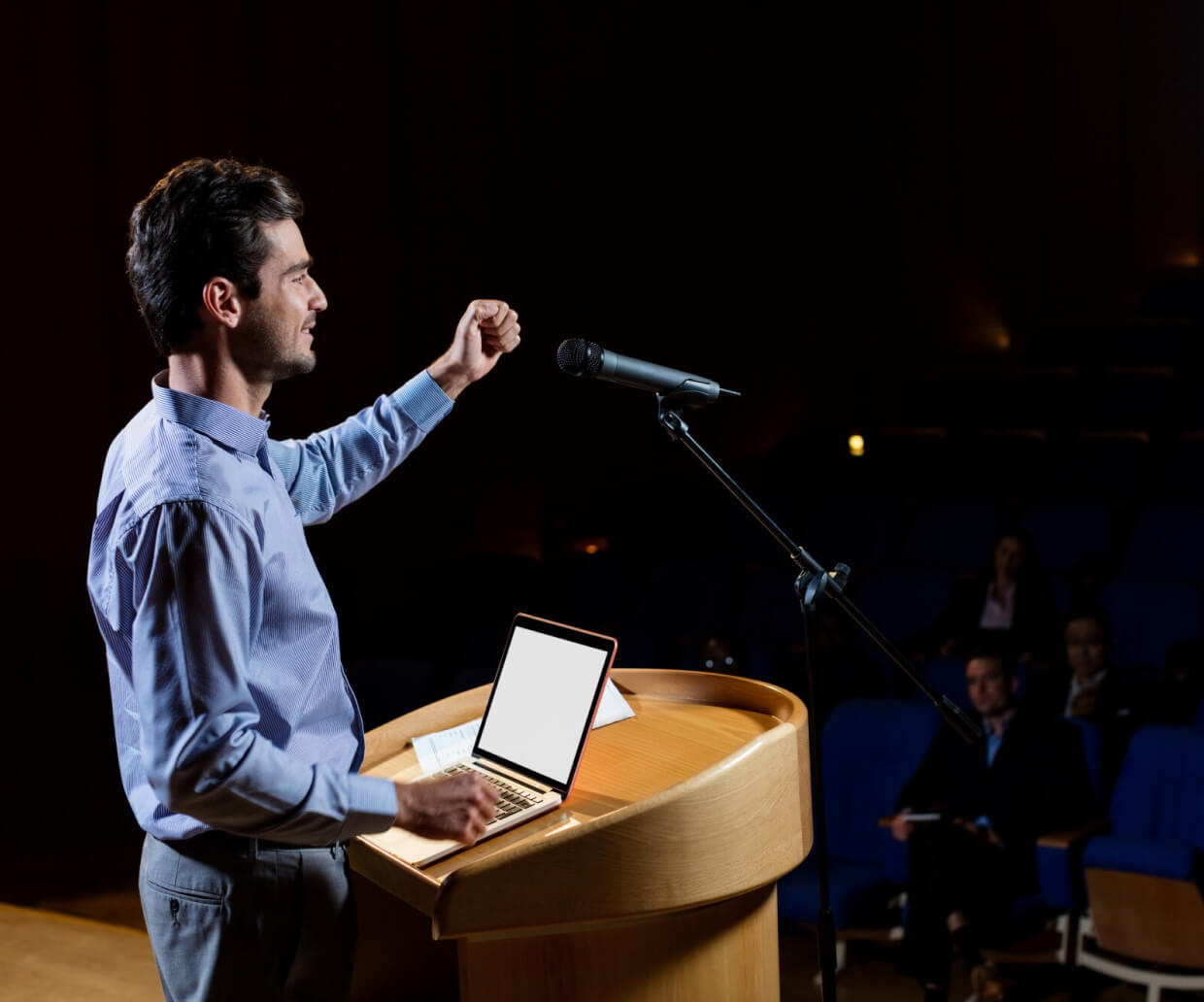
Wired microphones offer the most dependable connection. There's no battery to die mid-presentation and no risk of wireless interference from other devices nearby. For fixed positions — a podium, a boardroom table, a church pulpit — a wired microphone is often the simpler and more reliable choice.
Many spaces use both: a wired microphone at a fixed podium, and a wireless handheld or lavalier microphone for guest speakers or Q&A sessions.
Wireless microphones give presenters freedom to walk around a stage, classroom, or boardroom without being tethered to a cable. This makes them a strong fit for trainers, teachers, and anyone who presents standing up and moving.
Wired microphones offer the most dependable connection. There's no battery to die mid-presentation and no risk of wireless interference from other devices nearby. For fixed positions — a podium, a boardroom table, a church pulpit — a wired microphone is often the simpler and more reliable choice.
Many spaces use both: a wired microphone at a fixed podium, and a wireless handheld or lavalier microphone for guest speakers or Q&A sessions.
What sound system is right for a boardroom or conference room?
A boardroom sound system usually needs a mixer-amplifier, two or more surface-mount or ceiling speakers, and a microphone suited to how meetings run in that room. For most boardrooms, a wired microphone at the table works well for everyday meetings, paired with surface-mount speakers for clear, even sound across the table.
If the room also handles video calls or hybrid meetings, the sound system should be designed to work alongside the room's video conferencing setup, not separately from it. The Brain Computer Corporation can design these two systems to work together from the start.
If the room also handles video calls or hybrid meetings, the sound system should be designed to work alongside the room's video conferencing setup, not separately from it. The Brain Computer Corporation can design these two systems to work together from the start.
What sound system is right for a retail store?
Retail sound systems typically use a 70-volt distributed system with ceiling speakers spread evenly through the store. This setup supports background music, in-store announcements, and promotional audio without creating loud or quiet spots as customers move through the space.
For stores with more than one distinct area — a checkout zone, a fitting room area, an entrance display — a zone mixer lets you play different content or set different volumes for each part of the store. Many retailers also need a public performance license to legally play licensed music in-store; this is worth confirming with your music provider when setting up the system.
For stores with more than one distinct area — a checkout zone, a fitting room area, an entrance display — a zone mixer lets you play different content or set different volumes for each part of the store. Many retailers also need a public performance license to legally play licensed music in-store; this is worth confirming with your music provider when setting up the system.
What sound system is right for an auditorium or school assembly hall?
Auditoriums need a sound system built for both speech and performance. That usually means a digital mixing console with enough inputs for multiple microphones, a music source, and any stage instruments; a set of speakers powerful enough to reach the back row clearly; and microphones suited to presentations, performances, and assemblies alike.
For schools especially, ease of use matters. Staff who aren't trained audio engineers should be able to run the system for a normal assembly without difficulty. Systems with simple presets, mobile app control, or one-knob adjustments make this easier for non-technical staff to manage day to day.
For schools especially, ease of use matters. Staff who aren't trained audio engineers should be able to run the system for a normal assembly without difficulty. Systems with simple presets, mobile app control, or one-knob adjustments make this easier for non-technical staff to manage day to day.
Installation, Service, and Warranty
Is delivery and installation included in the quotation?
Yes, delivery and installation are included in the quotation unless otherwise stated.
Do you have in-house technicians for installation, servicing, and support?
Yes, we have in-house technicians who handle installation, servicing, and technical support.
Having in-house service capability means that when a maintenance issue arises, the same team that installed your system is the team that comes to resolve it — with direct knowledge of your specific installation, its configuration, and its history.
Having in-house service capability means that when a maintenance issue arises, the same team that installed your system is the team that comes to resolve it — with direct knowledge of your specific installation, its configuration, and its history.


