June 10, 2026
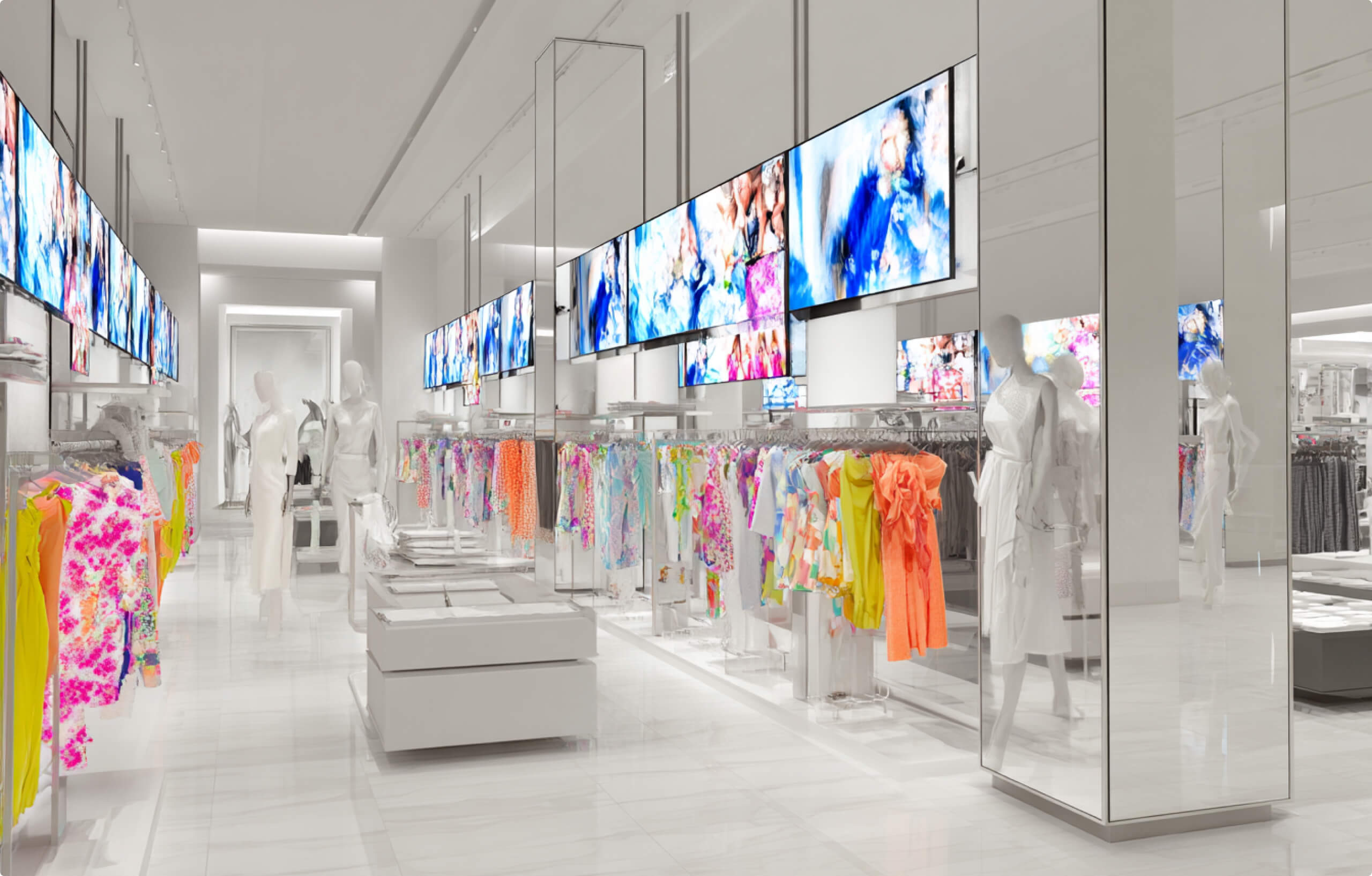
There is a predictable pattern that plays out in retail digital signage projects. A business invests in high-quality displays—perhaps LED panels for the shopfront window or a video wall near the entrance—and then waits for results that don't arrive at the expected scale. The screens look impressive. Customers glance at them. But foot traffic doesn't noticeably increase, dwell time inside the store barely shifts, and the sales lift fails to justify the investment.
The cause is almost always the same: the hardware decision came before the content strategy.
Digital signage is a communication medium. Like any medium, its effectiveness is determined almost entirely by the quality of what it communicates, to whom, at what moment, and in what context. A well-placed screen running irrelevant, static, or poorly timed content will consistently underperform a modest screen running precisely targeted, contextually appropriate messaging.
This article is written for marketing managers, retail operations leaders, procurement teams, and anyone involved in specifying or managing in-store digital display systems. It covers what a content strategy for retail digital signage actually consists of, why the details matter more than most buyers expect, and how to structure an approach that produces measurable outcomes—increased footfall, longer dwell time, and improved sales conversion.
Before getting into the mechanics of what good content strategy looks like, it is worth establishing why it matters so much more than most stakeholders anticipate.
Industry research consistently demonstrates the commercial potential of well-deployed retail digital signage. According to data compiled by Grand View Research and cited by multiple industry sources, the global digital signage market was valued at approximately $28.83 billion in 2024 and is projected to reach $45.94 billion by 2030, expanding at a compound annual growth rate of 8.1%—a growth trajectory driven substantially by retail adoption. The retail sector alone accounts for around 21% of global digital signage deployments.
The performance benchmarks, when signage is executed well, are compelling. Retailers using digital signage have reported average sales increases in the range of 29–32% on featured products, and studies suggest that retail stores implementing digital displays can experience up to 24% increased foot traffic. Digital displays capture approximately 400% more views than static signage and achieve message recall rates of around 83%, compared to far lower figures for print-based media.
But here is the figure that matters most for any organisation considering a digital signage investment: research indicates that approximately 80% of digital signage installations fail to meet their stated objectives—and the most commonly cited reason is not hardware failure or poor placement. It is the absence of a coherent content strategy.
The implication is clear. The technology, when deployed at a basic level, is reliable and broadly proven. What separates high-performing installations from underperforming ones is the discipline with which content is planned, produced, scheduled, and optimised.
These two metrics—foot traffic and dwell time—are related but distinct, and they require different content approaches to influence effectively.
Foot traffic refers to the volume of customers who enter a retail space. For a standalone store, the relevant screens are those visible from outside: window displays, external-facing LED panels, mall corridor screens, and signage positioned at entrances. The content goal here is interruption and invitation: giving a passing pedestrian a reason to stop, look, and step inside. This requires high-contrast visuals, extremely concise messaging, and content that communicates a tangible reason to enter—a promotion, a product reveal, or a brand experience—within two to three seconds of exposure.
Dwell time refers to how long a customer stays inside the store once they have entered. Longer dwell time correlates strongly with higher basket values, because additional time in-store increases the probability of discovering products, engaging with promotions, and making unplanned purchases. The content approach for dwell time is different: it needs to entertain, inform, and guide. Research from Digital Signage Today indicates that interactive digital signage can increase customer dwell time by up to 30% when effectively implemented—and that the accompanying boost to sales ranges from 20–30%.
Both goals need to be mapped explicitly before any content is created or any screen is specified.
The most common structural mistake in retail digital signage is treating all screens as interchangeable—running the same content loop on every display regardless of where it sits in the store or how long customers typically spend in front of it.
Effective content planning is built around zones, with each zone defined by the typical dwell time, customer mindset, and conversion goal of that location.
Screens visible from outside the store or in high-traffic corridors serve one purpose: generating walk-ins. The appropriate content here is punchy, visually dominant, and limited to a single message per slide. Think of it as a billboard. Viewing time is two to five seconds. Text must be minimal—a headline, perhaps a price point, perhaps a brand logo. Motion and high-contrast colour are critical for catching peripheral vision.
A useful principle: if a shopper walking at normal pace cannot absorb the core message before the screen passes out of their sightline, the content is too complex for the zone.
As customers cross the threshold, their pace typically slows and their attention broadens. This zone is an opportunity to frame the visit: highlighting store-wide promotions, introducing seasonal campaigns, providing wayfinding cues for large-format stores, and reinforcing brand values. Content can be slightly longer—eight to twelve seconds per slide—and can carry a secondary message alongside the primary one. This is also an effective location for loyalty programme prompts, new arrival announcements, and time-limited offers designed to prime purchasing intent.
Screens positioned adjacent to product categories serve a fundamentally different function: they support purchasing decisions at the point of consideration. This is where product storytelling earns its return. Use cases include demonstration videos showing products in context, side-by-side comparisons, customer review highlights, and cross-sell suggestions pairing complementary items. Dwell time in these zones is moderate—shoppers are actively browsing—and content can be correspondingly richer, with loops of thirty to sixty seconds.
The checkout zone is a persistently underutilised opportunity in most retail digital signage strategies. Customers in a queue have high dwell time and, crucially, low alternative stimulation. This creates a captive but not captivated audience. Effective content in this zone focuses on loyalty programme registration, impulse purchase prompts for high-margin lower-cost items, social proof content such as customer reviews, and brand storytelling. The tone should be conversational rather than promotional—customers at checkout have already committed to purchasing; the content goal is relationship-building and basket extension, not persuasion.
Beyond zonal structure, the timing and sequencing of content within a loop is one of the most overlooked technical aspects of digital signage strategy—and one of the most consequential.
Loop length should reflect the typical dwell time of the zone. A general industry guideline, well supported by deployment experience, is to keep individual content loops between five and ten minutes for medium-dwell areas such as category zones, and shorter—two to three minutes—for high-traffic, low-dwell areas such as entrances and corridors. A loop that exceeds the typical dwell time of the zone effectively means many customers will only ever see the first portion of your content rotation.
Slide duration within a loop should be calibrated by content type. A single promotional image with a headline works at five to eight seconds. A product demonstration video earns fifteen to thirty seconds if the content is genuinely engaging. A complex informational display—nutritional content, product specifications, technical comparisons—should be positioned only in zones where customers have a reason to stand and read.
Content freshness is a commercial imperative, not just a best-practice recommendation. Regular customers stop engaging with static digital content within two to three visits, according to deployment research. This has significant implications for content governance: a digital signage deployment without a structured content update schedule will see diminishing returns from its second month. A realistic content management plan should include weekly topical updates for promotional content, monthly refreshes for evergreen brand and product content, and immediate-trigger capability for real-time events such as weather-responsive promotions or stock-driven price changes.
One of the most significant developments in retail digital signage over the past three years is the maturation of dynamic, data-driven content delivery—and understanding this shift is increasingly important for any organisation making a signage investment.
Traditional digital signage operates on a scheduled playlist: a pre-built sequence of content items that plays on rotation according to a time-of-day schedule. This model is still appropriate for many deployments, and for smaller retailers it remains the most practical approach. But it represents only one point on a capability spectrum that now extends considerably further.
Dynamic content triggers allow content to change automatically based on external inputs—without manual intervention. Common trigger types in retail deployments include:
The commercial case for dynamic content is not speculative. One analysis found that digital displays with dynamically updated content can lift recall by up to 83% over static signage—a difference attributed largely to the human brain's heightened response to motion and change. Research from various retail pilots also points to sales uplifts of 20–30% in zones where contextually relevant, dynamically triggered content replaced static promotional loops.
It is worth being clear about the implications for system design. Dynamic content requires a robust content management system (CMS) with API connectivity to data sources, clear governance around content templates, and a defined operational workflow for content triggers. Buyers who specify hardware without accounting for these operational requirements will end up with capable screens running basic static playlists—capable of more, but not configured for it.
The visual and structural quality of the content itself is the final determinant of whether a screen captures attention or gets ignored. Several design principles emerge consistently from deployment experience and audience research.Hierarchy of message
Every piece of digital signage content should have one primary message. Not two. Not three with a secondary offer and a social media handle and a loyalty programme callout. One. Supporting information can exist, but it must be visually subordinate and legible within the time available. The primary message should be communicable within the first glance.
Animation and video outperform static images in capturing attention—this is well-established. But motion used gratuitously, without a meaningful content purpose, produces visual noise that desensitises rather than engages. The principle should be: use motion where it adds communicative value, not simply to add energy to a screen.
Retail screens are typically viewed from three to ten metres, often while walking. Font sizes, contrast ratios, and colour choices need to be tested at actual viewing distances and angles, not just on a design monitor. High-contrast text on a clean background—dark text on light, or light text on dark—dramatically outperforms mid-tone colour combinations at reading distance.
Digital signage exists within a broader brand environment. Fonts, colours, and visual language should be consistent with the brand's other customer touchpoints—print, packaging, website, social media—to reinforce recognition and create a coherent in-store experience. Inconsistent visual language across digital and physical brand materials undermines both the signage and the broader brand impression.
The most effective digital signage in retail does not feel like advertising. It feels like a service. Helpful information—product availability, store navigation, wait time estimates, event announcements—builds goodwill alongside promotional goals. A screen that tells a customer where to find something they are looking for earns more trust than a screen that simply tells them what to buy.
An investment in digital signage content strategy should be accompanied by an investment in measurement. Without a defined measurement framework, it is impossible to determine whether content changes are producing results or simply consuming budget.
The primary metrics worth tracking in a retail digital signage context are:
Research suggests that applying analytics to digital signage campaign management can increase campaign effectiveness by up to 25%. The implication for procurement decisions is practical: a content management platform with strong analytics capability is not a premium add-on; it is an operational requirement for any deployment where ROI accountability matters.
Understanding content strategy also means understanding the operational and technical requirements it creates. Before finalising a digital signage brief or investment, decision-makers should have answers to the following:
Digital signage is not a set-and-forget system. It requires ongoing content production, scheduling, and governance. If this responsibility is not assigned to a named team or function before go-live, the screens will run stale content within weeks—and stale content is functionally equivalent to no content at all from an engagement perspective.
The CMS is the operational backbone of the deployment. It should be evaluated for ease of use by the internal team responsible for managing it, connectivity to relevant data sources (inventory, CRM, weather), scheduling capability, and remote management across multiple screens or sites.
How will new content be briefed, designed, approved, and uploaded? For multi-site retailers, this workflow needs to account for national versus local content, promotional timing windows, and compliance with brand guidelines.
A single-store pilot has very different requirements from a fifty-location rollout. The CMS, connectivity infrastructure, and content workflow should be specified with the eventual scale in mind, not just the initial installation.
For deployments using audience analytics or AI-driven personalisation, understanding the applicable data protection requirements—and building compliant consent mechanisms into the system design—is a legal and reputational necessity, not a post-implementation consideration.
For procurement managers and financial decision-makers evaluating the investment case for digital signage, the content strategy conversation directly affects the ROI model.
The broad-level statistics are encouraging: industry data suggests that for every dollar invested in operational digital signage, businesses return four to six dollars, with payback periods averaging six to eighteen months across verticals. For retail specifically, featured products promoted via digital signage show average unit sales lifts of around 32%, and overall sales increases in the range of 29–32% have been reported by retailers who deploy strategically.
But these figures represent optimised deployments. An installation with strong hardware and weak content strategy will not approach these outcomes. The realistic modelling exercise for any retail digital signage investment should therefore include not just hardware and installation costs, but the ongoing operational cost of content production, CMS licensing, and analytics—and should set KPIs against which the system's performance can be evaluated and adjusted.
A well-structured AV integration partner will help buyers develop this model before the hardware specification is finalised—because the content requirements should drive hardware choices, not the reverse. Screen brightness, resolution, and format should all be selected in the context of what content will play on them, how close viewers will be, and what ambient conditions the display will operate in.
The strategic principle underlying everything in this article is straightforward: in retail digital signage, the content strategy is the primary investment, and the hardware is the vehicle through which it is delivered.
This is a different framing from how most digital signage conversations begin. Hardware is visible, tangible, and easy to specify in a budget. Content strategy is operational, ongoing, and harder to quantify upfront. But the evidence is consistent: deployments that invest in both produce dramatically better outcomes than deployments that invest in hardware alone.
For retailers considering a digital signage investment—whether for a flagship store refresh, a new branch rollout, or an upgrade of existing screens—the most valuable early conversation is not about display size or pixel pitch. It is about what you want to communicate, to whom, where in the store journey, and how you will keep that communication fresh and relevant.
That conversation, conducted with the right AV partner, is where measurable retail outcomes begin.